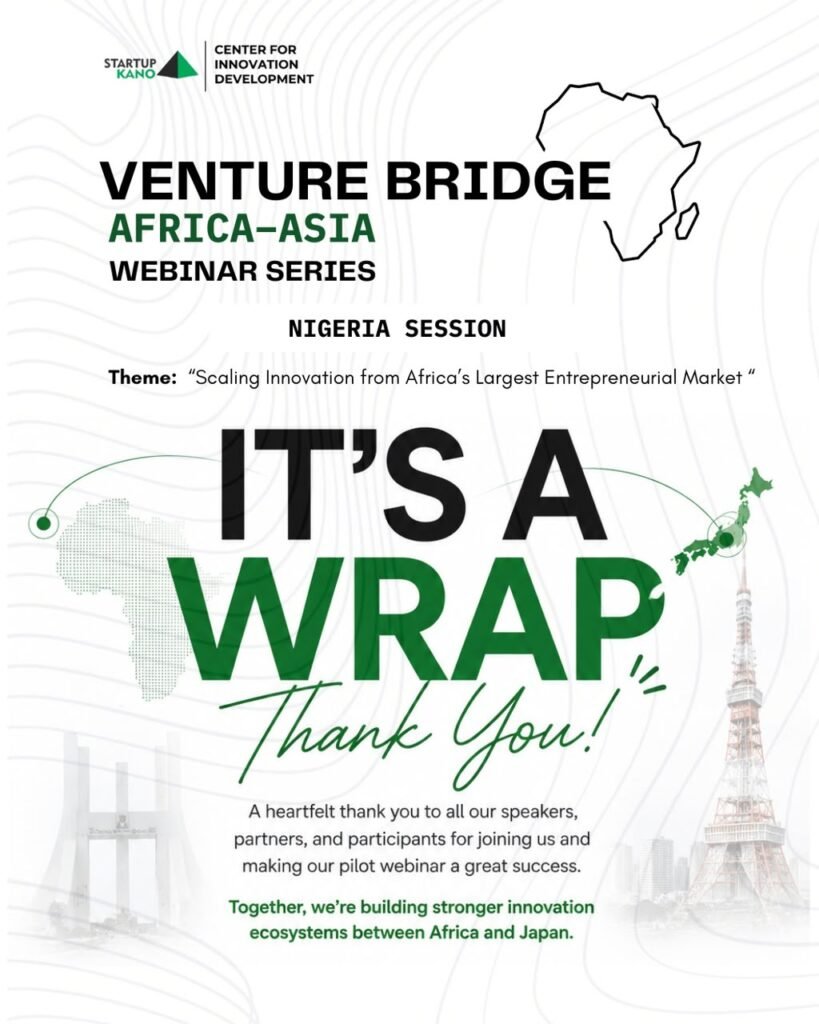
On 31st July 2026, Startup Kano officially launched the Africa-Asia Venture Bridge Webinar Series, a new initiative designed to connect African startup ecosystems and select ventures with Asian investors, mentors, and innovation partners. The series was conceived as more than a one-off event; it marks the beginning of a structured pathway that starts with ecosystem visibility and investor dialogue, and is designed to progress toward startup mentorship, investment readiness, and deeper partnership development, eventually feeding into a planned virtual venture studio.
Nigeria led the pilot phase as the series' inaugural country session, with Uganda, Egypt, and Zambia set to follow in the months ahead. Each country session in the series follows the same structure: an ecosystem context briefing, curated startup pitches, an investor perspective, and open discussion on investment support and cross-border collaboration.
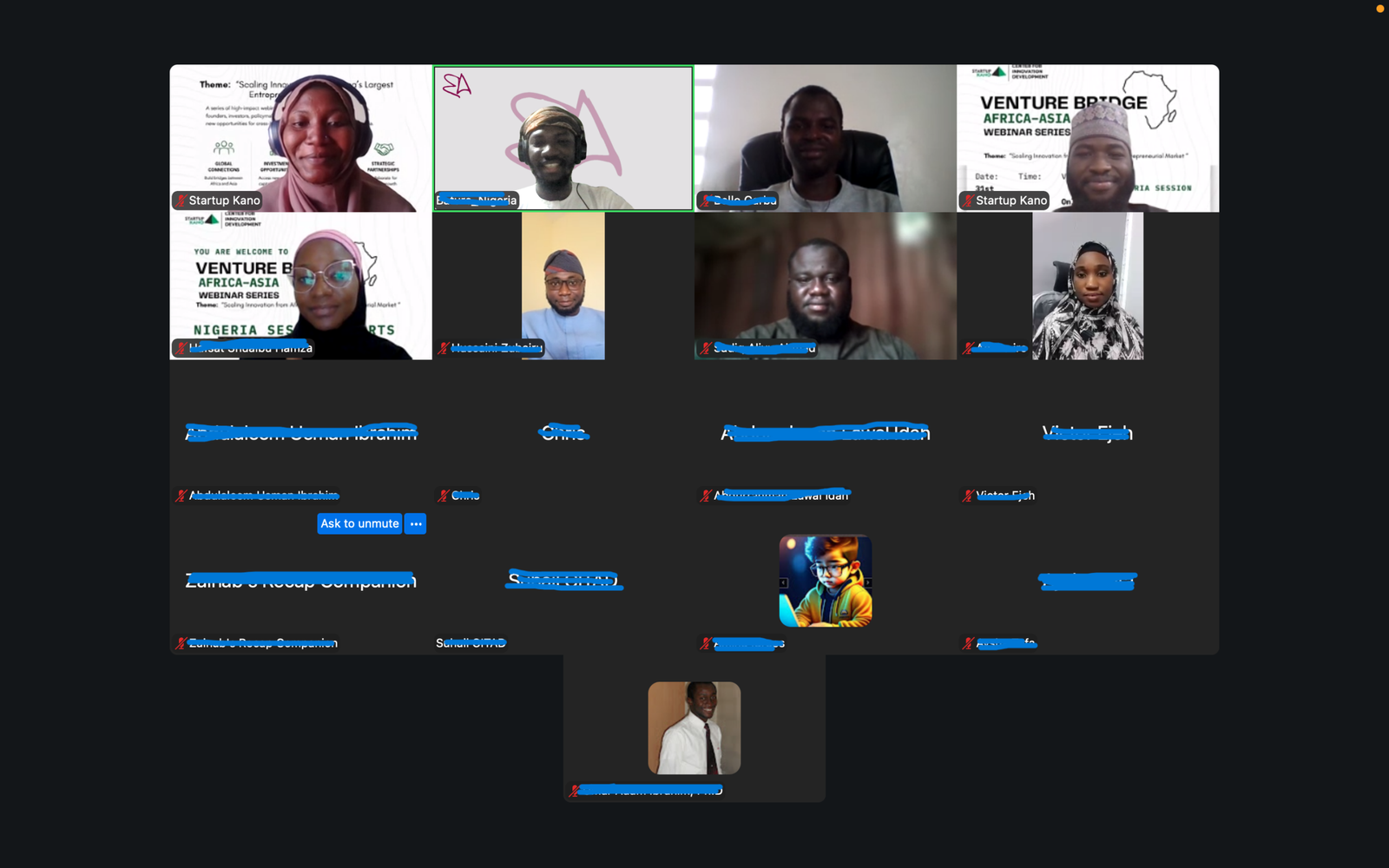
The Nigeria session, themed "Scaling Innovation from Africa's Largest Entrepreneurial Market," 55 people registered within one week for the session and 43 attended the full 90-minute session, a turnout that reflects genuine interest from founders, ecosystem players, and investors alike. Attendees described the session as educative and engaging, with substantive exchanges continuing well into the Q&A segment.
Setting the Tone: Why This Series Exists
The session opened with Ahmad Bature, Co-Founder of Startup Kano, framing the purpose of the webinar for participants, explaining that the series was convened to address a persistent gap in African innovation: founders across the continent are building real, tested solutions every day, but too often lack the visibility, partnerships, and investor access needed to scale beyond their home markets. Ahmad set the context for why a structured Africa-Asia dialogue, rather than a one-off pitch event, was the right vehicle to begin closing that gap.
He then handed over to Aida Isah El-Hassan, Managing Director of Startup Kano, to deliver the official welcome address.
Aida welcomed participants joining from across Nigeria, other African countries, and Asia, describing the moment as a reflection of a shared belief that innovation thrives when ecosystems connect, collaborate, and create opportunities beyond borders. She noted that what many African founders need most isn't more ideas, but greater visibility, stronger partnerships, and access to new markets and investors, which is why this series was created. She framed the Venture Bridge as Startup Kano's effort to bring together African innovators, ecosystem leaders, investors, and strategic partners to exchange ideas, build relationships, and open doors for collaboration, expressing hope that the session would mark the beginning of many meaningful, lasting partnerships between Africa and Asia rather than a single isolated engagement.
Aida also took a moment to specially acknowledge Jun Kojima, Director of Ant Capital, Japan, thanking him for his collaboration, trust, and commitment in helping bring this initiative to life. She closed her remarks by thanking the ecosystem partners, speakers, startup founders, and every participant who made the session possible, before handing back to Ahmad to guide the rest of the program.
Country Ecosystem Briefing: Nigeria's Digital Innovation Landscape
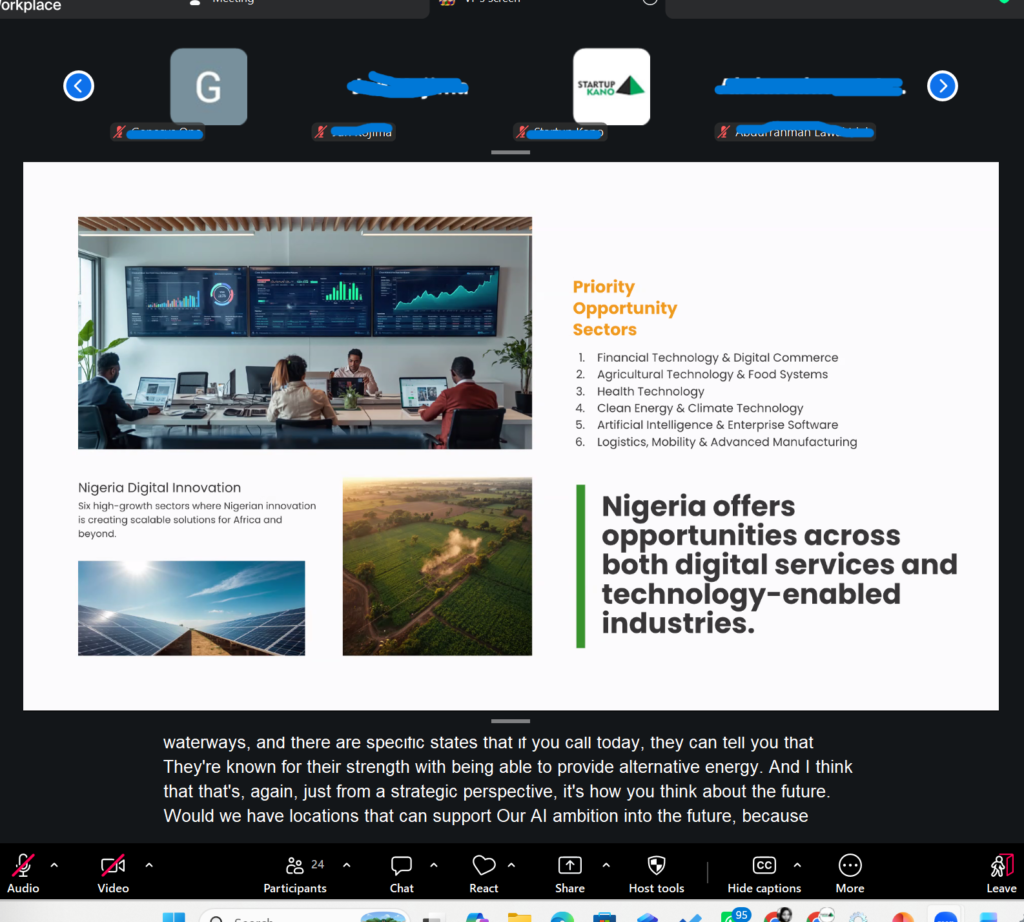
Delivering the Country Ecosystem Briefing, a 15-minute segment placed immediately after the opening, was Victoria Fabunmi, National Coordinator of the Office for Nigerian Digital Innovation (ONDI) under NITDA. Her participation was specifically requested to add institutional credibility and policy perspective to the session, giving Asian investors, mentors, and strategic partners a grounded overview of Nigeria's innovation landscape, ecosystem strengths, policy environment, and emerging opportunities.
Victoria brings over 15 years of experience across venture capital, private equity, and startup ecosystem development to the role. Before joining ONDI, she was an Investment Principal at Atlantica Ventures, where she led investment readiness programs and supported innovation hubs across the continent. She has also co-founded three successful technology-enabled businesses, giving her a rare combined vantage point as policymaker, investor, and founder. Her briefing touched on Nigeria's startup and digital innovation ecosystem, key sectors and opportunity areas relevant to investors, recent policy and institutional developments supporting startup growth, the role of public and private ecosystem actors in enabling innovation, and why Nigeria as Africa's largest entrepreneurial market is positioned as a natural anchor for Africa-Asia startup collaboration. The session's focus areas of mobility, commerce, enterprise technology, creative economy, and climate innovation were reflected directly in the lineup of startups featured later in the program.
The Investor Perspective: A View from Asia
Representing the Asian investor community was Jun Kojima, Director at ANT Capital, Japan, a key partner in bringing the Venture Bridge series to life alongside Startup Kano. Jun brings extensive cross-border investment experience across private equity, venture capital, and portfolio management, with a career spanning leadership roles at Golden Egg Ventures, DG Ventures, Japan Post Capital, Manulife, and Visa Worldwide. He holds a B.A. from the University of Sydney and a Master's degree from the University of Technology Sydney.
His session offered participants a candid, practitioner's view of what Asian investors look for when evaluating African ventures: the diligence priorities, market signals, and partnership structures that matter most from a cross-border investment standpoint. As co-creator of the series, Jun's presence also underscored that the Venture Bridge isn't a one-directional showcase, but a genuine two-way exchange built jointly by African and Asian partners from the outset.
Startups in the Spotlight
Five Nigerian startups pitched during the showcase segment, spanning minerals, robotics, energy, developer infrastructure, and mobility, a deliberate cross-section reflecting the session's stated focus areas:
GenesysOne: Founded by Ubaid Sulaiman, GenesysOne is building a platform to turn Africa's fragmented mineral supply into verified, traceable, export-ready inventory. Using blockchain-backed Digital Product Passports with GPS origin data, lab assays, ESG scoring, and carbon footprint tracking, the company addresses a systemic trust gap in global mineral supply chains. Miners currently lose 40-60% of potential value due to lack of price transparency and market access, while buyers face unverifiable origins and regulatory exposure. The company has $2M in lifetime offline GMV, a copper pilot running in Tanzania, four MOUs with large-scale mining companies, and four LOIs worth $8M in its pipeline. GenesysOne is raising SGD 500K in pre-seed funding.
Dalton: Founded by Yaseer Abdussalam and Jacob Gill, Dalton is building what the founders describe as the missing "reliability layer" for physical-world AI infrastructure that helps deployed robots and physical systems continuously evaluate failures, learn from real-world adaptations, and retain new skills locally without the cost, latency, or black-box risk of retraining foundation models in the cloud. The company positions itself between unreliable, expensive cloud-based approaches and rigid legacy automation, aiming to make foundation-model-powered robotics safe and production-ready for sectors like manufacturing, logistics, agriculture, and healthcare labs. Its revenue model combines a per-robot subscription for its edge runtime, enterprise cloud service fees, and OEM revenue-sharing partnerships.
Interface: Founded by Al-Amin Idris alongside co-founders Halima Mohammed and Aliyu Mukhtar Kuki, Interface connects small businesses across Africa to solar providers and financiers, addressing a market where over 40 million businesses are left without reliable electricity, collectively spending an estimated $14 billion annually on costly, polluting alternatives like fossil-fuel generators. The company operates on a 5% commission model on successful solar financing transactions and uses machine learning to generate insights on energy needs and customer pre-qualification. To date, Interface has powered 50,000 homes and businesses, unlocked $7 million in solar financing, and saved an estimated 80,000 metric tonnes of carbon emissions, growing at an average of 44% month-on-month. The company is seeking $2,000,000 to onboard, train, and equip 1,000 agents across 10 Nigerian communities.
SendCore: An AI-native email infrastructure platform for developers, AI agents, and engineering teams, SendCore offers transactional APIs, broadcast campaigns, and agent-ready inboxes with MCP integration, positioning itself as the only email platform purpose-built for the AI agent era. The company reports processing 10M+ emails, a 99.97% deliverability rate, 99.99% API uptime, and a developer base of 5,000+, with enterprise customers citing reliability improvements from roughly 97% to 99.97% after switching. SendCore is currently raising a pre-seed round.
Letmoveit: A tech-enabled logistics platform tackling Nigeria's fragmented, unreliable relocation market. The company offers smart truck hailing with ML-powered dynamic pricing, a dedicated mobile app for its loaders network, a moving marketplace for packing materials and add-on services, and a corporate portal for bulk enterprise relocations. The startup reports serving 7,500+ customers, ₦200M+ in platform revenue, ₦1.5B+ in total transaction volume, and a network of 500+ verified trucks and trained loaders, with 3x growth over the past 12 months. Founded by Adeyanju Odofin and Meduoye Alfred, the company is raising a $300,000 pre-seed round.
Looking Ahead
With Nigeria's inaugural session setting a strong benchmark for both content depth and audience engagement, the Africa-Asia Venture Bridge series now moves on to its next stops: Uganda, Egypt, and Zambia, as Startup Kano and Ant Capital work to build out a lasting bridge between African innovation and Asian capital, mentorship, and market access. Startup Kano extends its thanks to all ecosystem partners, speakers, founders, and participants who made the inaugural session possible, and looks forward to welcoming the community back for the next country spotlight.