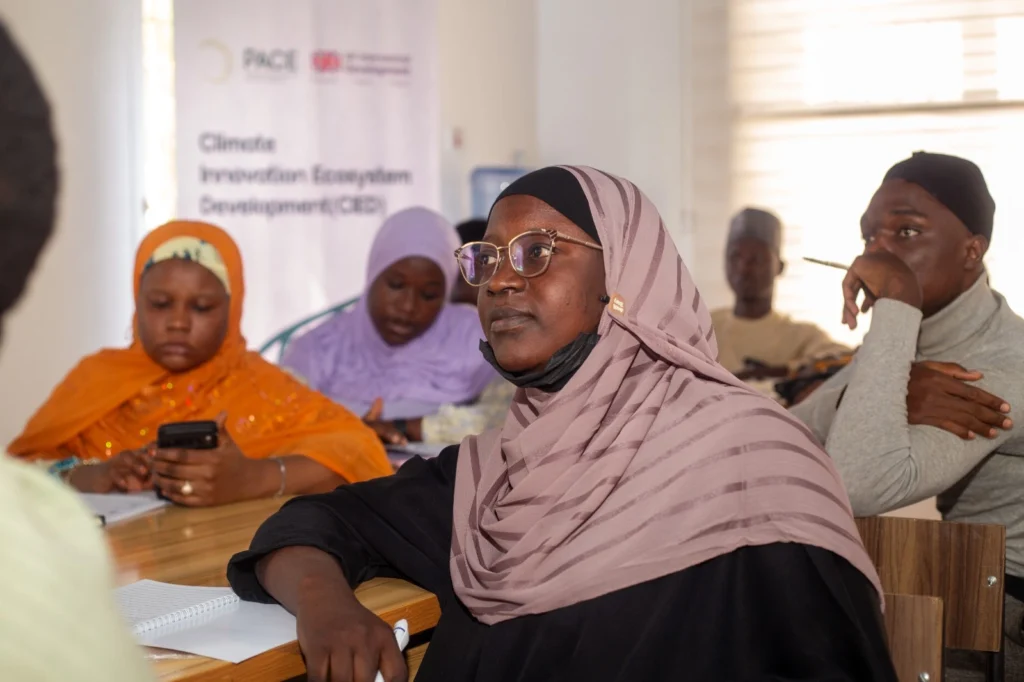
As we progress in the Climate Innovation Ecosystem Development (CIED) Program, the focus shifts from momentum to depth. This stage of the journey is about strengthening structure, sharpening clarity, and ensuring that every idea being developed is built on a solid and intentional foundation. Participants are challenged to think more critically, design more strategically, and align their ventures with long-term impact.
The focus during this phase is on strengthening participants’ thinking, design, and structuring of their climate ventures.
The learning begins with structured problem-analysis tools, specifically the Fishbone (Cause-and-Effect) Model and the 5 Whys technique. These frameworks guide participants in systematically diagnosing climate-related challenges before designing or scaling solutions. Through the Fishbone Model, the participants are categorizing potential causes such as operational inefficiencies, resource constraints, policy limitations, technological gaps, behavioral patterns, and environmental factors. The 5 Whys technique strengthens this analysis by encouraging iterative questioning to uncover deeper systemic root causes rather than symptoms. Following this investigation, Domain Definition enables participants to clearly define the specific problem domain, the boundaries of their solution space, the stakeholders involved, and the broader environmental and economic context. This ensures that every climate solution is built on validated, well-understood problems grounded in rigorous analysis.
Rather than rushing into refining solutions, participants pause to examine the systems behind the problems critically. They ask deeper questions, explore contributing factors, and challenge their own assumptions. This stage ensures that every business idea moving forward is anchored in evidence and clarity, not guesswork.
With this clarity established, the focus shifts to structured business design using the Economic Business Model Canvas (BMC). Participants map out their Customer Segments, Value Propositions, Revenue Streams, Cost Structure, Key Activities, and Key Partners. This process strengthens their understanding of financial viability and ensures their ventures are economically sustainable.
Facilitated feedback and peer learning encourage founders to refine their cost assumptions, examine the realism of their revenue streams, and ensure that their value propositions clearly align with the needs of their identified customers. The goal remains clear: a climate-focused startup must also be a financially sound business.
The session then expands to the Environmental Layer of the Business Model Canvas, where startups assess Resource Inputs, Energy Use, Waste Generation, Emissions, Environmental Footprint, and Lifecycle Impact. This stage emphasizes aligning business operations with measurable environmental responsibility.
Participants are encouraged to think beyond good intentions and examine the actual environmental implications of their models. They explore how materials are sourced, how energy is consumed, what waste is produced, and how their solutions create positive environmental outcomes. This strengthens the connection between their climate mission and their operational design.
Finally, participants integrate the Social Layer of the Triple Layer Business Model Canvas, focusing on Stakeholder Mapping, Social Value Creation, Community Impact, Employment Generation, Ethical Considerations, and Risk Mitigation. They are guided to connect all three layers: economic, environmental, and social, into one coherent model.
At this stage, the emphasis is on integration. Founders are encouraged to see their startups as interconnected systems where profitability, environmental stewardship, and social responsibility reinforce one another. The exercise helps participants build ventures that are not only viable and climate-aligned, but also inclusive and community-conscious.
By the end of this phase, participants have developed structured, climate-smart business models rooted in analysis, strengthened by financial logic, aligned with environmental goals, and responsive to social realities. It marks meaningful progress in the CIED journey, transforming ideas into integrated systems designed for sustainable impact.